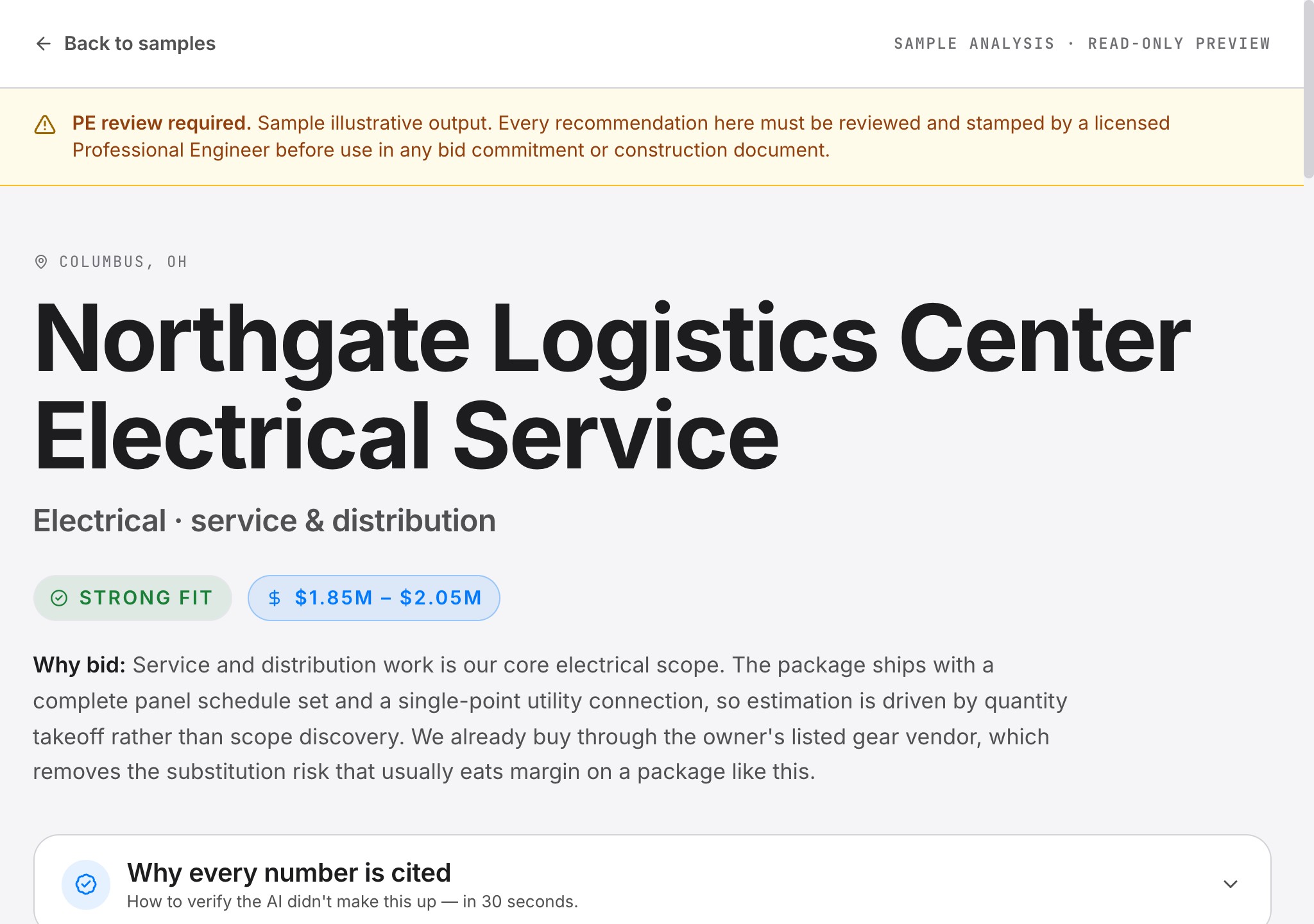
The strongest way to judge bid-intelligence output is to read it. So here is an annotated walkthrough of what a BidCertain analysis produces — a bid-fit score, risk flags, a cited cost framework, and auto-RFIs — on a representative project. This is a sample from our library, built to show the output's shape. It is not a real customer's estimate and not a real project. Read it the way you would read any tool's output: as a structured first pass you hand to a licensed professional engineer or your own reviewer before any bid commitment.
The project: a speculative 480,000 SF distribution center needing a new electrical service and full interior distribution. Below is each section of the output, what it contains, and — importantly — what it does and does not tell you to do.
Project summary: the read before you open a drawing
The analysis opens by framing the project the way a good estimator would before takeoff:
A speculative 480,000 SF distribution center with a new 2,000A, 277/480V service and full interior distribution for dock equipment, rack lighting, and an EV-ready parking field. The GC of record issued a complete panel schedule set with a single-point utility connection at the pad-mounted transformer. Gear lead time of 26–32 weeks on the main switchboard sets the critical path and must be released at notice-to-proceed to hold the tenant delivery date. The scope also carries a 1,200A dock busway and a 40-port Level 2 charging field, both as owner allowances. No tenant fit-out is in this package, which keeps the takeoff clean and the scope bounded.
Three things are worth noticing. First, it names the supply condition that drives the design — a single-point utility connection at a pad-mounted transformer, which removes line-side ambiguity. Second, it names the constraint most likely to move the number — a 26–32 week switchboard lead time that sets the critical path. Third, it separates owner allowances (the dock busway and charging field) from base scope before the cost roll-up, which is exactly the distinction that keeps a bid clean. That is the read a good estimator makes; the analysis makes it explicit and cited to the documents.
The bid-fit score: STRONG — and why
The single most useful number is whether the job fits your trade and your shop. The output grades STRONG / MODERATE / WEAK, with the reason:
"Service and distribution work is our core electrical scope. The package ships with a complete panel schedule set and a single-point utility connection, so estimation is driven by quantity takeoff rather than scope discovery. We already buy through the owner's listed gear vendor, which removes the substitution risk that usually eats margin on a package like this."
The reason is not a slogan — it is the specific fit argument, tied to what makes this package priceable (clean panel schedules, one utility connection, an approved gear vendor). The framework is honest in the other direction too: a WEAK fit is worth as much as a STRONG one, because it tells you to pass before you sink a week into a set.
Key findings: what the set actually says
Before pricing anything, the analysis pulls out the findings that drive the estimate, each cited to a sheet or spec section:
| Finding | What it means for the bid | Source |
|---|---|---|
| Utility delivers 480V, 3-phase at a single pad-mounted transformer | No utility-side switchgear or primary coordination in scope — removes the line-side contingency that normally drives a large allowance | Drawing E-001, Project Manual 26 05 00 |
| 26–32 week switchboard lead time sets the critical path | The main switchboard and 38 panelboards ship as one gear order; release at NTP with a locked 90-day price | Spec 26 24 16, Section 1.6.C |
| Dock busway and charging field widen the package past base distribution | Both are owner allowances; pricing them as alternates keeps the base bid clean and preserves upside if the owner takes them | Drawing E-301, Panel Schedule EP-4 |
That third finding is the kind that decides a bid's shape rather than its number: whether an item is base scope or an alternate changes what you are signing up to build.
Preliminary sizing: quantities you can check
The output gives the quantities a takeoff would produce, so you can sanity-check them against the set:
| Item | Quantity |
|---|---|
| Service | 2,000A, 277/480V, 3-phase, 4-wire |
| Main switchboard | 1 ea, 2,000A service-entrance rated |
| Panelboards | 38 ea (277/480V and 120/208V) |
| Feeders | ~14,800 LF, aluminum in EMT / RGS |
| Dock busway | 1,200A, 480 LF (owner allowance) |
| Charging field | 40-port, Level 2 (owner allowance) |
The risk flags: ranked, with a mitigation
The output surfaces the risks that would otherwise surface after you have won and signed:
| Severity | Risk | Mitigation |
|---|---|---|
| HIGH | Switchboard lead time slips past the tenant delivery date | Release the gear PO at NTP. Lock pricing and ship date for 90 days; qualify a second gear vendor as backup. |
| MEDIUM | Utility transformer setting and service point shift during coordination | Hold service coordination until the utility issues a firm service point; carry a feeder re-route allowance. |
| MEDIUM | Underground feeder routing conflicts with the site storm and water lines | Clash-check the ductbank against the civil package before bid; require a recorded utility plan at preconstruction. |
| LOW | Charging-field specification and port count still open | Price the charging field as a unit-rate alternate; exclude the owner's network subscription. |
None of these is discovered by reading faster. They are discovered by reading the conflicts — the electrical package against the civil set, the spec against the bid form, the schedule against the gear lead time. The HIGH flag is procurement, and it is the one that decides whether you hit the tenant delivery date.
The cited cost framework: drivers, not a number in thin air
Before any bottom line, the analysis gives the drivers — each traceable — so you can see what moves the number and challenge it:
- Main switchboard and panelboard gear order (single-point release)
- Feeder conductor and raceway — ~14,800 LF across the interior distribution
- Dock busway and charging-field allowances, priced as alternates
- Labor loading for a fast-track tenant delivery schedule
The point is not the specific estimate range ($1.85M–$2.05M on this sample). The point is that every driver is a line you would price anyway, and each is written down so you and your reviewer can check it against the set. The output is a cost framework, not a takeoff: it tells you what drives cost and where the alternates sit; you still price against your own rate database and your own shop's numbers.
Auto-RFIs: the questions you would have sent yesterday
The analysis ends with the clarifications that should go out before bid day, each with a priority and a reason:
1. HIGH — Who furnishes and installs the pad-mounted transformer, owner or contractor? The bid form lists "service equipment" without delineating line-side responsibility. A $180–260K swing on transformer and primary conductors.
2. MEDIUM — Is the dock busway base scope or an alternate? Drawings show the busway but the bid form carries no line item. Moves the base by roughly $210K.
3. MEDIUM — Confirm the charging-field port count and whether networking is in scope. Spec and drawings disagree at 32 vs. 40 ports; the network subscription is owner-furnished in one section and contractor in another.
These are the RFIs a sharp estimator sends anyway. The tool's job is to surface them from the set, cited, before you have spent hours — not to answer them. Resolving them is still a conversation with the GC or the engineer.
What the output does NOT do — the honest edge
Because this is a design-assist tool, the edges matter as much as the center:
- It is not a takeoff engine. It reads plans, specs, and RFPs and produces a structured, sourced analysis; precise quantity takeoff still lives where you keep it.
- It is not an instruction to bid. A strong bid-fit and a clean cost framework do not tell you to bid. The go/no-go call remains yours.
- It requires PE/professional review. Preliminary sizing and system selection are engineering output that a licensed professional engineer must verify and seal before any bid commitment. No accuracy is guaranteed; the citations exist so that review is fast and grounded.
- It is honest when to pass. A WEAK fit, an owner you cannot get paid by, a risk you would rather not carry — the framework surfaces all of it. Design-assist means the honest answer, faster, not a greener light.
Want to see this on your own project?
This is a sample, and a sample can only show you the shape. The way to judge whether the output matches how your shop prices is to run a real bid package through it. Book a 30-minute demo and we will walk a real set — your drawings, your specs, your addenda — through the same cited analysis live, so you can read the bid-fit score, the risk flags, and the auto-RFIs on work you actually recognize. No account needed to look.
Sources
[1] BidCertain sample library — Northgate Logistics Center Electrical Service (illustrative, not a real customer or project). Bid-fit score, key findings, preliminary sizing, risks, cost drivers, estimate range, and clarifications as surfaced in the sample analysis; document references cited within it (Drawing E-001, Project Manual 26 05 00, Spec 26 24 16, Drawing E-301) are part of the fictional sample set.
For reference, the electrical methodology behind this read is grounded in the same code basis the product cites for the trade: NFPA 70 (NEC) for installation, IEEE 1584 for arc-flash study scope, and NECA 1 for workmanship. Those are the references a reviewer would check; they are named here, not applied to your project.